EUROPEAN UNION DEFORESTATION REGULATION

EUROPEAN UNION DEFORESTATION REGULATION
September 2026
Midas Safety is closely monitoring all developments related to the EU Deforestation Regulation (EUDR, Regulation (EU) 2023/1115). As a responsible manufacturer, we are committed to ensuring our operations and working closely with our supply-chain partners to support the applicable EUDR requirements.
This document provides a structured overview of the EUDR’s scope, deadlines, and practical implementation steps, with a focus on how Midas Safety supports compliance across the natural rubber supply chain.
EU Deforestation Regulation (EUDR) – Overview
The European Union introduced the EU Deforestation Regulation (EU 2023/1115) as a critical measure to combat global deforestation and forest degradation. The Regulation establishes requirements for relevant products placed on or made available on the EU market concerning their deforestation-free status, legal production and applicable due diligence obligations. Compliance requires supply-chain due diligence to verify that relevant commodities are deforestation-free, including that they have not been produced on land subject to deforestation after 31 December 2020, and have been produced in accordance with the relevant legislation of the country of production.
Scope and Applicability
The EUDR applies to relevant products listed in Annex I that contain, have been fed with, or have been made using the seven relevant commodities:
- cattle,
- cocoa,
- coffee,
- oil palm,
- rubber,
- soya and
- wood.
The specific obligations of a company depend on its role in the supply chain, for example as an upstream operator, downstream operator, or trader.
Following the amendment of Annex I by Commission Delegated Regulation (EU) 2026/2102, the EUDR expressly applies to rubber derived from Hevea brasiliensis (commonly known as rubber tree). Products made from synthetic rubber are not covered under the rubber commodity. Natural rubber gloves falling under the relevant ex 4015 product category remain within the scope of the EUDR. Fully synthetic rubber gloves, such as nitrile gloves, are not subject to the EUDR under the rubber commodity.
Effective Dates and Transitional Periods
The EUDR entered into force on June 29, 2023, marking the start of the transitional period for all affected stakeholders, including importers, traders, and producers of key commodities.
Current Compliance Deadlines
- General application date: 30 December 2026
- Certain micro and small operators: 30 June 2027, subject to the conditions established under the Regulation. The applicable deadline and obligations depend on both company size and the company’s role in the EUDR supply chain.
- Medium and Large Enterprises: must comply by December 30, 2026
- Under the EU Deforestation Regulation (EUDR), the classification of an enterprise follows the general EU SME definition as set out in Recommendation 2003/361/EC and referenced in EUDR guidance.
A simplified Category structure:

Due Diligence Statement (DDS) Requirements
Where required under the EUDR, the upstream operator placing a relevant product on the EU market for the first time must conduct due diligence and submit the required Due Diligence Statement through the EU EUDR Information System before placing the product on the market. Obligations for downstream operators and traders differ where the relevant products are already covered by upstream due diligence. The specific obligations vary depending on the risk classification of the country of origin.
Full Due Diligence for Non-Low-Risk Countries
If the product originates from a country not classified as low-risk, the operator must complete a full due diligence process. This includes gathering geolocation data, verifying legal production, and conducting a risk assessment to determine the likelihood of deforestation or illegality. Where risks are identified, appropriate risk mitigation measures — such as supplier audits, certification, or additional documentation — must be undertaken and justified.
Simplified Due Diligence for Low-Risk Countries
If a relevant product is placed on the EU market and originates from a country categorized as “Low Risk” under the regulation, the operator is allowed to skip the Risk Assessment and Risk Mitigation steps. The operator must collect and retain the information required under Article 9, including, as applicable:
- Product Description: for example, natural rubber disposable gloves
- HS Code: for example 4015
- Net Quantity: Specified in kilograms or pieces
- Country of Production: for example Sri Lanka
- Geolocation: GPS coordinates of each plantation supplying raw material
- Harvest/Production Period: Month and year of production
- Supply Chain Traceability: Documentation supporting traceability from plantation through manufacturing to the EU customer/operator.
EUDR Information System
The EU operates an online platform called TRACES (TRAde Control and Expert System) to track and manage imports. For the EUDR, a specialized EUDR Information System has been established as an online tool within the TRACES platform. The operator must retain appropriate supporting evidence and submit the required Due Diligence Statement and associated information through the EUDR Information System.
Supporting service providers can be used to simplify the process through direct integration with the EUDR Information System. Midas Safety, if provided access to such service providers, can enter supply related information directly.
EUDR implications with Midas Safety
In Annex I of the EUDR, HS codes are listed that correspond to product categories which may contain materials associated with deforestation — for example, natural rubber. Gloves made of vulcanized natural rubber under HS 4015 therefore fall within the scope of the regulation (4015 – Articles of apparel and clothing accessories (including gloves, mittens and mitts), for all purposes, of vulcanized rubber other than hard rubber). Disposable Natural Rubber gloves manufactured by Midas Safety Lanka (MSL) fall under HS code 4015 as defined by Regulation (EU) 2023/1115. As a responsible manufacturer, MSL has aligned its supply chain and internal systems with EUDR requirements to support our customers in meeting their regulatory obligations.
- MSL has evaluated selected suppliers sourcing natural rubber from countries classified as low risk under the EUDR, with a focus on the availability of information required to support EUDR due diligence.
- MSL is prepared to provide relevant available supply-chain information to support customers in fulfilling their applicable EUDR due diligence requirements.
- MSL is open to integration with customer-preferred digital platforms
- Where the customer acts as the upstream operator placing the relevant product on the EU market for the first time, the customer is responsible for fulfilling the applicable EUDR due diligence requirements. Midas Safety supports this process by providing relevant available supply-chain, traceability, geolocation and supporting information.
Midas Safety Deliverables – Supply Chain Integrity and Traceability
At Midas Safety, we have implemented traceability and supply-chain control measures designed to support EUDR requirements for relevant natural rubber products, from raw-material sourcing through production and delivery to our customers.
1. EUDR-Related Sourcing Controls
For relevant EUDR products, natural rubber is sourced from selected suppliers that are ready to provide supporting traceability and due diligence information. For every batch of raw material received, we obtain:
- Polygon data (geolocation coordinates) of the plantations supplying the latex
- A supplier declaration supporting applicable EUDR due diligence requirements
- The quantity of centrifuged latex covered by the relevant traceability and supplier documentation
- Certificate of Analysis (COA)
2. Dedicated Raw Material Storage
To reduce the risk of material mix-up or loss of traceability, Midas Safety has implementedphysical segregation and batch controls as part of its internal EUDR traceability system. This physical separation supports a clear and auditable material flow.
3. Controlled Production Process
During manufacturing, only approved and fully traceable natural rubber batches supported by relevant EUDR-related supply-chain information are used. These are tracked through our internal systems to maintain traceability and reduce the risk of unintended mixing with other materials.
4. Post-Production Handling and Shipment
Once production is complete:
- Relevant traceability and supporting documentation is made available to customers, as applicable.
- Information is transmitted either directly to the customer or via integrated digital platform providers.
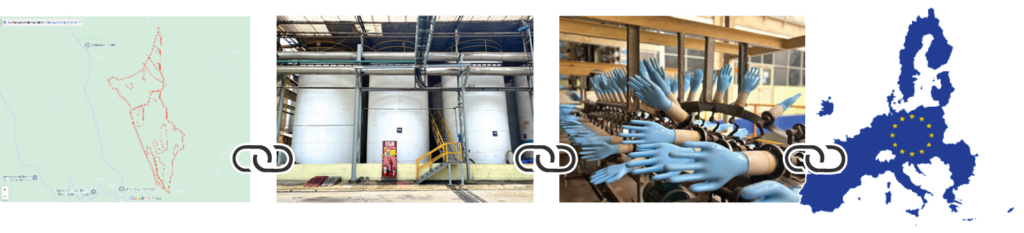
Geolocation / Separate Tanks / Dedicated Batches / EU Import Declaration & Documentation
Through these measures, Midas Safety aims to provide customers with a controlled and traceable natural rubber supply chain, supported by information and documentation intended to facilitate fulfilment of applicable EUDR obligations.
Midas Safety, 18.09.2026
Disclaimer: This document is provided for general informational purposes and reflects Midas Safety’s current understanding of Regulation (EU) 2023/1115. It does not constitute legal advice. We recommend consulting a regulatory specialist for guidance specific to your legal situation.